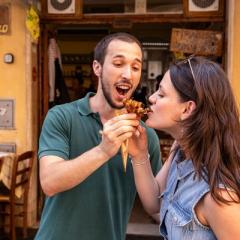
📄What a Trastevere twilight food tour involves — the stop-by-stop shape of the evening, what's guaranteed, what isn't, and who the format doesn't suit.
ℹ️Quick Answer
A Trastevere twilight tour runs 3–4 hours across 6–7 stops, delivering around 10 tastings and several drinks — a full dinner, not a snack crawl. The sequence follows how Romans eat: aperitivo at an enoteca, supplì from a fry counter, a spritz at a neighborhood bar, a sit-down course of Roman pasta with wine, then gelato. It's an evening format because Romans rarely eat dinner before 8 p.m. Note that while pizza, pasta and gelato are guaranteed, the famous named restaurants often aren't.
Almost every serious Trastevere food tour runs at dusk, and that isn't an aesthetic choice — it's a scheduling one. Romans don't sit down to dinner before about 8 p.m., and the ritual that precedes it, the aperitivo, is a genuine institution rather than a marketing device: a drink and something to pick at, taken standing or seated at an enoteca, in the hour when the working day dissolves into the evening. A tour that starts at six or seven is simply arriving when the neighborhood does.
There's a second reason, which is that Trastevere is two different places depending on the hour. By day it's a quiet residential grid of ochre walls and parked scooters. After dark the tables come out, the piazzas fill, and the neighborhood becomes the thing people came to see. A tour timed to twilight catches the transition — you start in the last of the light and finish under it. That the format is also called "twilight" by its best-known operator is marketing; that it works is not.
The Shape of the Evening, Stop by Stop
Formats vary between operators, but the underlying arc is remarkably consistent, because it mirrors a Roman evening rather than inventing one. It typically opens with a seated aperitivo at an enoteca — sparkling wine with olives, lupini beans, cold cuts and cheese — which sets the pace and lets the group meet each other. Then comes the street food: a supplì from a fry counter that has been making the same recipe for decades, and Roman pizza, often pizza bianca, the plain, salt-and-oil slab that Romans treat as a staple.
The middle of the tour is where the neighborhood's character comes through — a deli or food hall for porchetta, cured meats and pecorino, a neighborhood bar for a spritz taken standing the way locals do, and often something fried and seasonal like artichokes or courgette flowers. Then the centerpiece: a sit-down course of Roman pasta — usually two of Amatriciana, Gricia, Cacio e Pepe or Carbonara — at a family-run trattoria, paired with wine. And it closes with artisanal gelato, almost always with a short lesson in telling real gelato from the industrial kind, which is a genuinely portable skill.
Across six or seven stops you'll get roughly ten food tastings and five or six drinks in three to four hours. That's a full dinner and then some; the standard advice from operators and guides alike is to arrive hungry and not to eat lunch late.
Stage
What Happens
Typical Tastings
🥂 Aperitivo
Seated enoteca — the Roman pre-dinner ritual
Sparkling wine, olives, lupini, cold cuts, cheese
🍙 Street food
A fry counter that's been at it for decades
Supplì, pizza bianca
🥓 Deli / food hall
Cured meats and cheese counter
Porchetta, salumi, pecorino
🍺 Neighborhood bar
A spritz taken standing, like locals
Spritz; often something fried and seasonal
🍝 Sit-down course
Family-run trattoria — the centerpiece
Two Roman pastas + wine
🍨 Gelato
Artisanal gelateria + real-vs-fake lesson
Gelato; sometimes a digestivo
A typical twilight tour runs 6–7 stops, ~10 food tastings and several drinks across 3–4 hours. The order and venues vary by operator, and specific venues are not guaranteed on every departure.
The trade-off: The arc is fixed, so you can't linger at the stop that fascinates you or skip the one that doesn't. What you get in exchange is a sequence built to work — aperitivo before food, street food before the sit-down, gelato last — which is exactly the order a Roman would eat in, and exactly the order most visitors get wrong on their own.
What's Guaranteed and What Isn't
This is the part almost nobody tells you, and it's worth reading before you book. Operators are clear in their fine print that the specific venues can change. One major operator states plainly that every departure includes a pizza tasting, a sit-down pasta dinner and gelato — but that renowned names may or may not be on your particular departure, and stops vary based on availability.
That matters because the famous venues are exactly what people think they're buying. If you've read that a tour visits a celebrated trattoria or an ancient wine cellar and you're booking for that reason, you may not get it — and the operator has told you so, in a line you probably skimmed. The honest way to read a food tour listing is to separate the guaranteed structure (a set number of stops, a pizza tasting, a plated pasta, gelato, a guide) from the illustrative examples (named restaurants, specific dishes, the cellar). Book for the first. Treat the second as a bonus.
None of this is a scam; availability at small family-run venues genuinely fluctuates, and a good guide substituting a comparable stop is doing their job. But it does mean the right question at booking isn't "does this tour go to X?" — it's "what does this tour guarantee?"
The trade-off: Booking for the structure rather than a specific venue means letting go of the exact evening you pictured. It's also the only way to book honestly, since availability at small family-run places genuinely moves — and the tours that guarantee least about venues are often the ones being most straight with you.
The Express Alternative
If three to four hours and ten tastings sounds like more than you want, there's a lighter option worth knowing about. Some operators run an earlier, express departure — typically around 6:15 p.m., lasting about two and a half hours — that trims the evening to its four essentials: a spritz, supplì, a sit-down dinner, and gelato. It costs less than the standard tour and is aimed at travelers short on time.
It's a sensible compromise for a first evening in Rome when you've just landed, for anyone who doesn't want to be eating at 10 p.m., or for a lighter appetite. What you lose is the middle of the tour — the deli, the extra fried things, the wandering — which is where a lot of the neighborhood's texture lives. If your priority is a good dinner with context, the express does the job. If it's the full arc, pay for the full arc.
The trade-off: The express gets you the essentials for less money and less time, but it's a compressed version of the experience — fewer stops, fewer tastings, less neighborhood. Worth it when time is the binding constraint; a false economy if you came to Rome specifically to eat.
Who the Format Doesn't Suit
Credit where it's due: the better operators are candid about this, and it's worth taking them at their word. One publishes explicitly that its tour is adaptable for vegetarians, pescatarians, dairy-free guests and pregnant women — but that it is not recommended for vegans, not recommended for anyone with celiac disease because of gluten cross-contamination risk, and not recommended for children because of the number of wine stops. That's an unusually straight set of statements in an industry that prefers "we'll do our best."
Read them as information rather than as a hurdle. If you're vegan or celiac, a general twilight tour is a poor fit and a specialist or private option will serve you far better. If you're travelling with children, the daytime format exists for exactly this reason. And there's a physical dimension too: the evening involves walking a couple of kilometers over sampietrini, Rome's uneven cobblestones, with stairs at some venues — which is why several tours state they aren't wheelchair accessible, and why the standing advice is comfortable shoes and no heels.
The trade-off: The twilight format's strengths — wine at every stop, late hours, a fixed group pace — are precisely what rule it out for some travelers. That's not a flaw in the tours; it's a format with a shape. The mistake is booking it hoping it will bend, when a daytime or private tour is built to.
How to Turn Up Right
Small things decide whether the evening starts well. Confirm your meeting point carefully, because they vary more than you'd expect: some tours gather in Piazza San Cosimato, others outside a specific venue on the edge of Piazza Trilussa (with listings that go out of their way to tell you not to wait in the square itself), others at Piazza Mastai behind a colored flag — and some meet across the river, at the Tiber Island or Piazza Farnese, and walk over the Ponte Cestio into the neighborhood. That last one is a longer evening than the listing's title implies.
Then the basics. Arrive about ten minutes early — several operators state that late arrivals aren't eligible for a refund, and a tour packed with timed reservations genuinely can't wait. Come hungry: skip a late lunch, because ten tastings is a real dinner and every guide's most repeated complaint is guests who ate at four. Wear comfortable flat shoes — the cobbles are unforgiving and heels are a mistake people make once. And dress for an evening that cools down, since you'll be outdoors between stops for a couple of hours after dark.
The trade-off: None of this is glamorous, and it's tempting to just turn up. But nearly every ruined food tour story begins with one of these — the wrong square, a late arrival, a full stomach, the wrong shoes — and all four are free to avoid.
Tour structure, stops, timings, group sizes, and dietary guidance reflect current 2026 information and vary by operator — venues are not guaranteed on every departure and change based on availability, so confirm what a specific tour guarantees before booking. Dietary suitability differs significantly between operators; several state their tours are unsuitable for vegans, celiacs, or children. Tours include alcohol; participants must be of legal drinking age in Italy (18). Several tours involve walking on uneven cobblestones with stairs at some venues and state they are not wheelchair accessible.
Common questions
❓ Why are Trastevere food tours in the evening?
Because that's when Romans eat. Dinner in Rome rarely starts before 8 p.m., and the aperitivo ritual that precedes it — a drink and small bites at an enoteca — is a real institution, not a tourist invention. A tour starting around six or seven follows the local rhythm rather than imposing one. Trastevere is also a different neighborhood after dark: quiet and residential by day, alive with tables and crowds at night. Evening tours catch that transition, which is why the format is often called a "twilight" tour. Daytime tours exist and suit families, but the evening is when the neighborhood is itself.
❓ Will my Trastevere food tour visit the famous restaurants listed?
Not necessarily. Operators state in their fine print that stops vary by availability and that renowned venues listed as examples aren't included on every departure. What is guaranteed on a typical twilight tour is the structure: six to seven stops, a pizza tasting, a sit-down pasta course with wine, gelato, and your guide. The named restaurants, the ancient wine cellar and specific dishes are illustrative rather than promised. If a particular venue is your reason for booking, ask the operator directly before you pay — otherwise, book for the structure and treat any famous stop as a bonus.
❓ Are twilight food tours suitable for children or people with dietary restrictions?
Often not, and the better operators say so. One states its tour is adaptable for vegetarians, pescatarians, dairy-free guests and pregnant women, but is not recommended for vegans, not recommended for those with celiac disease due to gluten cross-contamination risk, and not recommended for children because of the number of wine stops. Families are usually better served by a daytime tour; vegans and celiacs by a specialist or private option. The format also involves a couple of kilometers of walking on uneven cobblestones with stairs at some venues, so several tours state they aren't wheelchair accessible.
About the Author
Mario Dalo
Founder & Research Analyst
I founded TrastevereFoodTour to apply the method we use across the Intercoper portfolio: read what thousands of travelers actually reported, verify what can be verified, and publish what the evidence supports — including the parts that don't help a booking.